


On our Kumakonda trips, we’ve had many encounters with the Wodaabe of Chad, and we even travel to their Gerewol festival every year. For us, this nomadic people—part of the larger Peul family—is one of the most fascinating on the African continent, which is why we’re publishing this article, in which we share much of the knowledge we’ve gained through our fieldwork and research. Keep reading—you’re in for a surprise!
The Origins of the Wodaabe of Chad
The Wodaabe, or Bororo, are a nomadic pastoralist people who are part of the larger Peul family, also known as the Fulani or Fulbé. They can be found across the vast Sahel region and in many countries in West and Central Africa. From Senegal to Chad and northern Cameroon, their silhouette is unmistakable on the horizon.
In the Peul world, nomads are called Bororo or Wodaabe, as opposed to the sedentary Guidda (“people who live in houses”).
But “Wodaabe” also means “uneducated“, as opposed to the Guidda, who are sedentary, have converted to Islam, and are well-versed in the Quran. In other sources, we have read that the name “Wodaabe” literally means “the people of the taboo.”
The Bororo, or Wodaabe, are a distinct minority among the Peul, with whom they share a common language: Fulfulde.
The Wodaabe are believed to have introduced pastoralism to West Africa.
One of the traits that has most baffled anthropologists and Africanists is their physical difference from other West African populations. The Fulani are neither white nor black, as their skin is more of a coppery color. Their hair is “straight and long,” and their facial features are delicate. This is so striking that, over time, various hypotheses have been put forward:

In 1860, Heinrich Barth—the famous German geographer and great explorer of Africa who traveled across the Sahara between Tripoli and Chad, and between Chad and Timbuktu— spoke of a great migration caused by the desertification of the Sahara. Evidence of this migration would be found in the cave paintings of the Sahara, in southern Algeria, which were studied and cataloged nearly a century later by Henri Lothe.
The Peul may be the people who, thousands of years ago, had to cross the Central Sahara in search of water and pasture, and the evidence can be found in the cave paintings of the Sahara.
The Rock Paintings of the Sahara and Their Connection to the Wodaabe of Chad
In Henri Lothe’s book *Vers d’autres Tasilis*, we find a passage that is truly moving. It recounts that, according to Fulani legends, their ancestors reached the Futa Djalon Mountains (in what is now the Republic of Guinea, or Guinea-Conakry) around the 8th century, crossing the Senegal River. They came from the East—that is, from the Sahara.
In the rocky shelters of the Tassili, in southern Algeria, there are cave paintings dating back many thousands of years. Classified into different periods, the ones of interest to us are believed to be between 5,000 and 3,000 years old.
They depict scenes of herding with cows that have lyre-shaped horns and people whose hairstyles and clothing closely resemble those of today’s Fulani.
Paintings of the same style and period have also been discovered in the Zemmur (Western Sahara), the Hoggar Mountains (Algeria), the Tibesti, and the Ennedi (Chad).
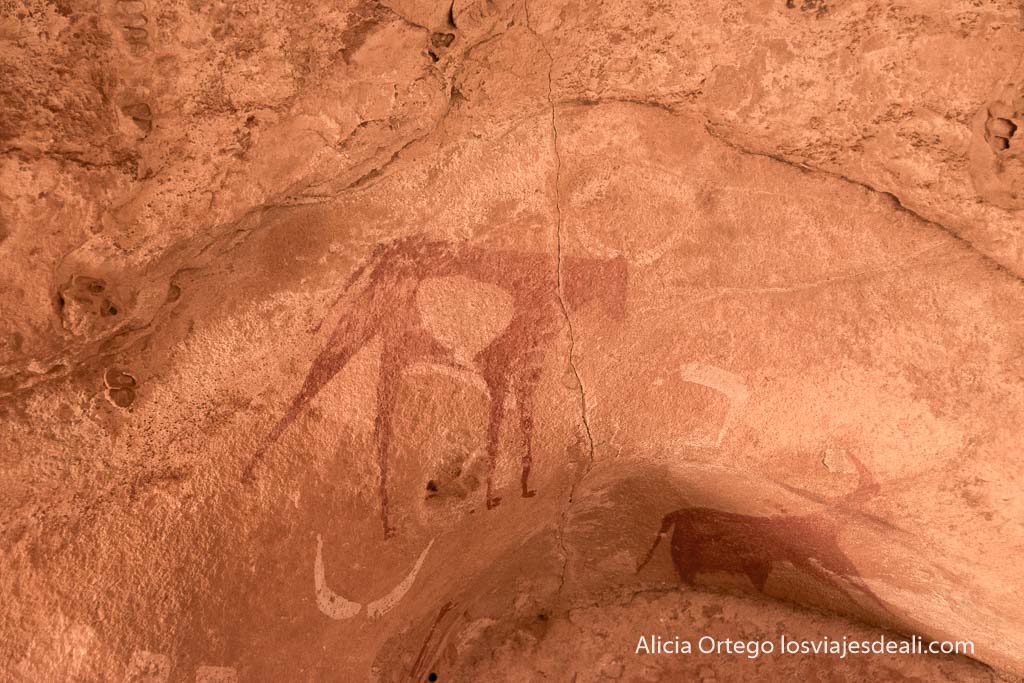

Henri Lothe recounts that Amadou Hampâté-Bâ—former Malian ambassador to Côte d’Ivoire, his country’s delegate to UNESCO, writer, and ethnologist—was surprised by the paintings that Lothe had copied from the Algerian Sahara, because he recognized various traditions of his people in them.
Amadou Hampâté-Bâ (1901–1991) was the author of the famous quote,“When an elder dies in Africa, a library goes up in flames.” Of Fulani descent, his family were Bororo or Wodaabe nomads. He grew up among them and became familiar with his people’s oral tradition, making him an authoritative voice on the subject.
The Lotori Ceremony
One such painting is the one depicting “schematic oxen,” found at Tin Tazarift (Tassili, Algeria). It is so named because the animals’ legs appear to be reduced to stumps, but for Amadou Hampâté-Bâ, they are simply animals standing in water. Furthermore, the figures appearing in the scene are celebrating the “lotori” ceremony.
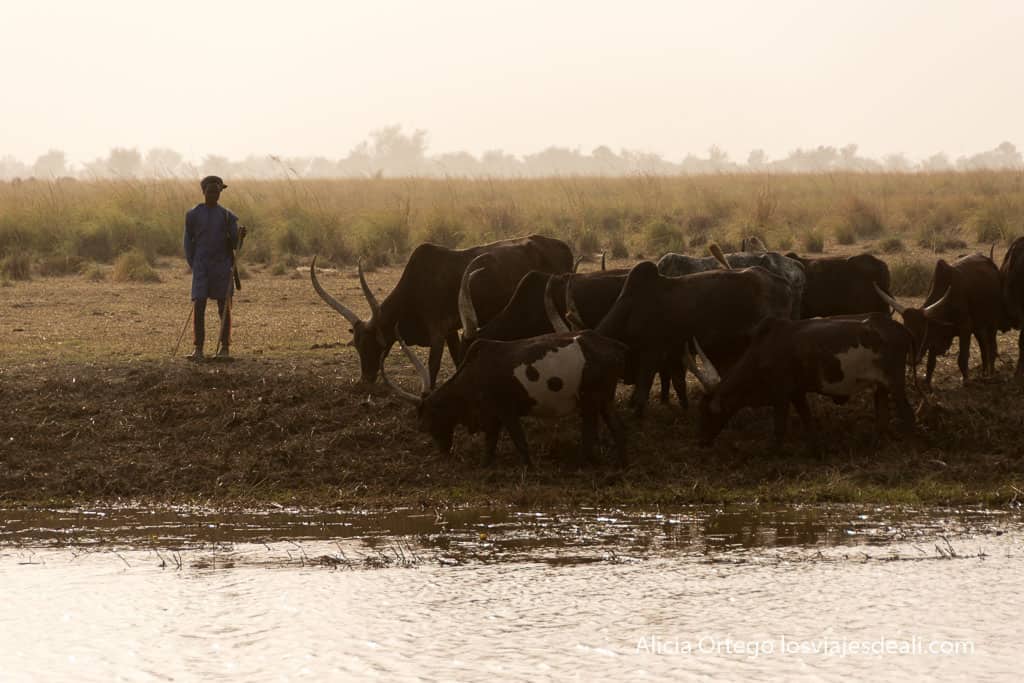
The “lotori” ceremony is a Bororo or Wodaabe tradition celebrated once a year. It consists of driving herds of cows and oxen to the nearest pond. During the night, the animals are washed in that pond in remembrance of the aquatic origin of cattle. According to Peul legends, they come from the water:
A man, his wife, and their children, camped near a pond, watched as cows emerged from the water at dusk, approached the fire, and returned to their pond at dawn. During the day, the man and his family would wander off, but at dusk the oxen would return to the fire, just as they had the day before. This coming and going repeated itself many times until one day the man, striving to keep the animals by the embers, managed to get them to stay.
A story by Amadou Hâmpaté-Bâ included in Henri Lothe’s book *Vers d’autres Tasilis*
Once the animals have been washed, dances are performed on the date designated by the eldest person, or “silatigui” ( “chief” in the Mandinka language), usually in November. This date is determined based on the 28-day lunar months and the relative positions of the 28 constellations that govern the herders’ year. A year consisting of 28 parts of 13 days each (28 × 13 = 364 days). For the “lotori” to be beneficial, 28 cows or bovines must participate.
Washing the animals is not only a ceremonial practice but also serves a preventive or sanitary purpose: to protect the animals from harmful bacteria and sterility.

The Symbolic Richness of the Wodaabe Nomads of Chad
Amadou Hampâté-Bâ also provided a very precise interpretation of another major element of the rock art scene: the “schematic oxen.”
It depicts the figure of a hand which, according to Amadou, is the hand of the first Fulani herder, named Kikala. It is a six-fingered hand that contains the original genealogy of the Fulani:
The number 4 encapsulates much more symbolic meaning found in Fulani legends. Let us also recall that their calendar is based on the number 28, a multiple of 4:
Thus, each major Peul family—whose lineage traces back to one of Kikala’s sons— has its own symbols and identifying marks that are perfectly coordinated and distinct from those of the others:
|
DYAL |
Yellow |
Fire |
East |
|
BA |
Red |
Air |
West |
|
SO |
Black |
Water |
South |
|
BARI |
White |
Earth |
North |
The painting also features 33 figures marching in a procession (some of whom are barely visible because they are in the darkest part of the painting). Their legs are also hidden because they are in the water, and they wear masks with large ears representing the “evil” animals of African folklore: the jackal, the fox, and the hare.
33 is the number of stages a novice must complete to attain full knowledge of the rites of pastoral initiation and earn the highest title of “Silatigui.” They also dance in a procession, forming an “S”— the dance of the Tyanaba serpent, who represents God on Earth.
When we encounter the nomadic Wodaabe groups of Chad on our trips, it’s easy to fall into the trap of thinking we’re dealing with a people whose customs and way of life are simple. A hard, labor-intensive life, dependent on water and their ability to find it—but simple, after all. Furthermore, it’s difficult to converse with them without a reliable interpreter who knows them well, and/or not everyone is willing to share their legends and beliefs. At least not during a chance, brief encounter.
But from the story of Amadou Hâmpaté-Bâ, the grandson of a Bororo or Wodaabe “silatigui,” one thing is clear: this people has its own fascinating worldview.
The Beliefs of the Wodaabe
It is said that the Wodaabe believe in a God, but they do not practice a religion in the strict sense of the word, with specific rituals and rules. They call their god “Allah” due to the influence of their Muslim neighbors, but conceptually, he is nothing more than a supreme force that can bring good fortune or misfortune, and who is invoked when hope is needed.
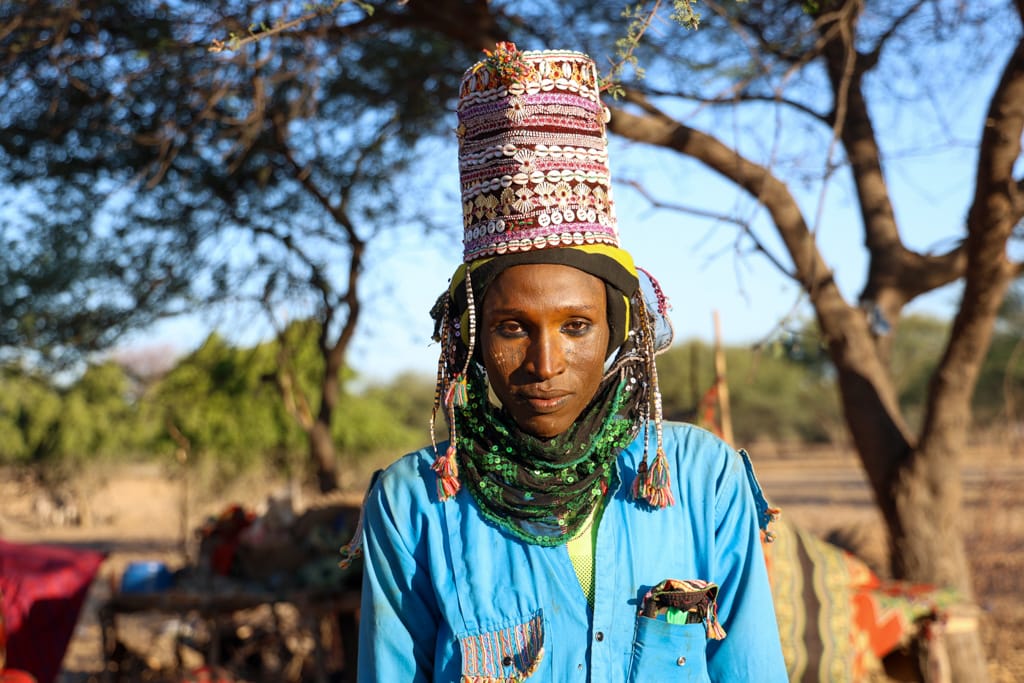
One thing that is never missing from their attire are the gri-gris—small, completely sealed leather pouches containing herbs, leaves, or roots with magical properties, as well as small pieces of paper with verses from the Quran. They are used for a wide variety of purposes, such as:
In addition, the Wodaabe use many traditional remedies made from leaves, the bark of certain trees, or fruits. These are used to combat madness, cure venereal diseases, treat snake and scorpion bites, and much more.
The Nomadic Life of the Wodaabe of Chad
As we mentioned, the nomadic life of the Wodaabe people of Chad is far from easy. For about seven months, they have to cope with a lack of rain and harmattan storms (desert dust). In fact, they are fortunate, because in neighboring Niger, the rainy season lasts only three months, and the fields are much more precarious.
But Chad has a much larger population and far more livestock. When water becomes scarce and the ponds and wells begin to dry up, conflicts with the Arabs, Tubus, and other pastoralist peoples of Chad erupt with great intensity. Everyone has livestock to care for, in addition to people. Without water, there is no life.
In any case, their adaptation to the arid environment of the Sahel’s desert and pre-desert regions is the reason for their nomadic lifestyle. They all face constant pressure to find pasture and water for their livestock, yet they cultivate the virtue of patience.
If you can’t stand the smoke, you’ll never be able to make a fire
Wodaabe Proverb
The Wodaabe are convinced that only by following tradition can they preserve their way of life. Anyone who chooses their own path—who insists on doing things their own way, differently from how they have always been done—will eventually lose their way.

Cattle and Children
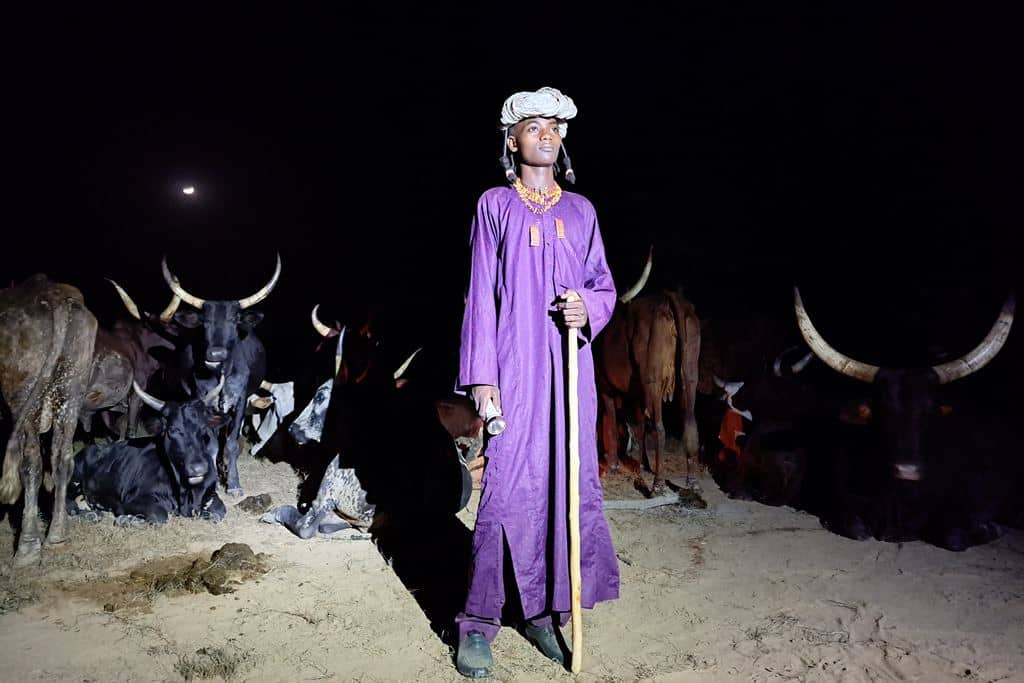
For the Wodaabe, livestock is the greatest treasure in life. They live in symbiosis with their livestock and develop a special bond with each of their animals. Each animal has its own name, chosen based on its physical appearance.
Cows in particular—but also goats, sheep, donkeys, and camels— are not merely assets that ensure their survival. The size of the herds and the types of animals they contain are symbols of social status.
A good Wodaabe’s herd must, at the very least, be sufficient to meet his needs. That is, there must be several cows that produce milk, some oxen to sell at the markets, some breeding bulls to ensure the herd’s survival through new offspring, and some young males to sacrifice during important ceremonies. Beyond that, the more animals they have, the wealthier they are; the more important the family is; and the more easily they can ensure food for all its members.

With the rains comes the “happy season” of the year—a time of abundance, when they have unlimited access to milk from their cows, which is the main staple of their diet. And that is when the various families and clans gather to celebrate their festivals, among which the Gerewol stands out.
Children are another very important factor for the Wodaabe of Chad, because they will be the support of their old age.
“A childless couple is like a tree without fruit, and they will be alone in their old age.”
However, they prefer to have sons because daughters will leave with their husbands when the time comes. If they happen not to have any sons, they may adopt one of their nephews, a decision that will be accepted by the entire group. Ultimately, it’s about preserving the family legacy and “carrying on the family name.”
Visiting a Wodaabe Camp in Chad
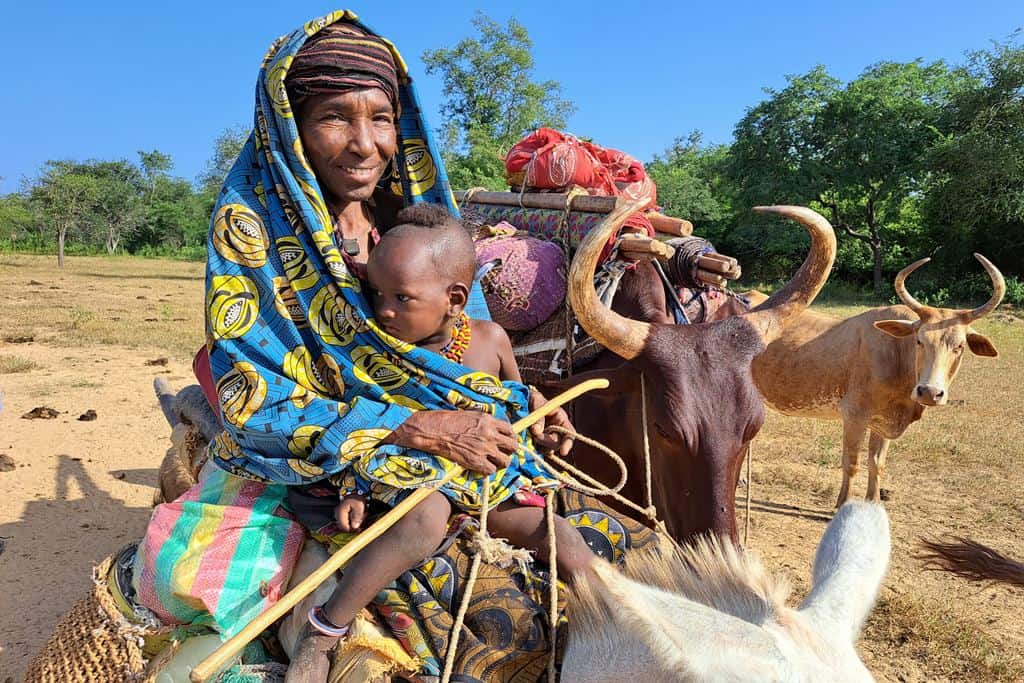
The homes of the Wodaabe people of Chad, called Denki, resemble bird nests, and in fact they say they live “like birds in the thickets.” Made of branches, they are arranged in a two-story structure. On the top level, they store their belongings off the ground, and on the “first floor” is their bed and resting area, covered with a mosquito net or some fine fabric that provides privacy and keeps out mosquitoes.

The belongings of Wodaabe women constitute their entire estate. They are the only possessions they can take with them if they leave their husbands. Notable among these are gourds decorated with engravings and baskets they have woven themselves. Today, however, these are used alongside metal pots and plastic containers.
A small fire is always burning next to the house, or Denki. It’s used to cook meals and provide warmth on cold nights.
The homes of the Wodaabe people of Chad are usually spaced some distance apart to ensure privacy. If there is brush, it serves as a screen. If not, they form a wide semicircle and are placed closer together to provide some protection.
Early in the morning and again in the late afternoon, the herds of cattle and their herders—always men—return to the camp. The cows gather near the houses. Sunset is the time to milk the cows to obtain their main source of food.
Meat is eaten only on special occasions, and whenever possible, it comes from small livestock: goats and sheep. Cows are slaughtered only on very rare occasions.
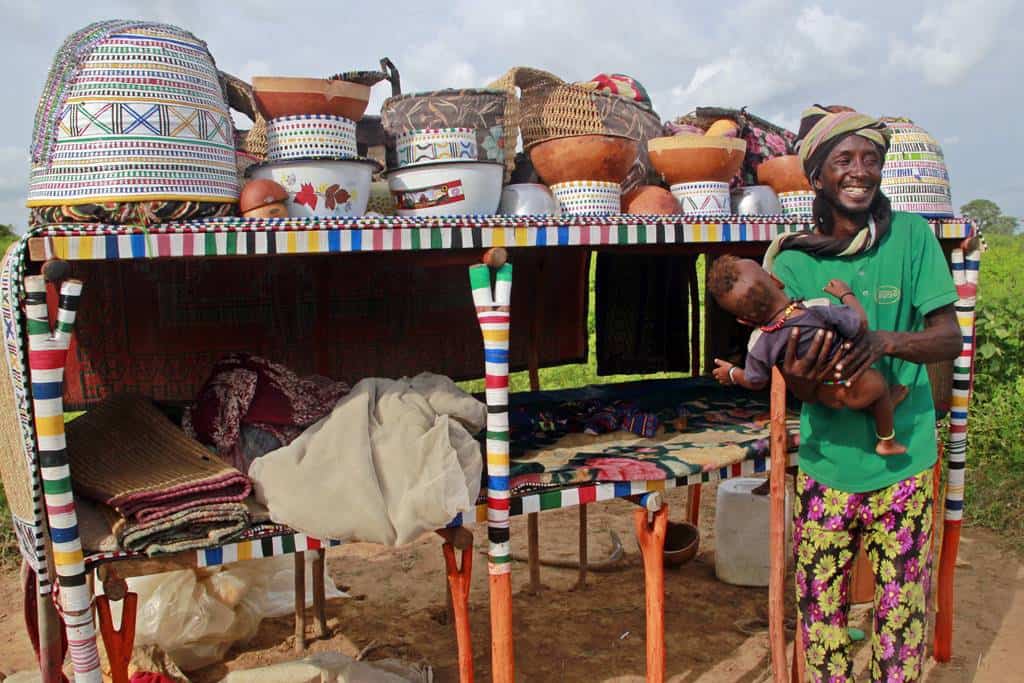
The men spend their days taking the animals to pastures and to wells or ponds where they can drink. They are responsible for finding the most suitable locations, as well as deciding which route to take when moving the camp.
Women’s daily routine consists of caring for their children, gathering firewood, fetching water, keeping the fire going, grinding millet, cooking, sewing, decorating gourds, weaving baskets, tending to their appearance, and milking the cows at dusk, among other tasks.
When night falls, they gather around the fire, wrapped in their blankets if it’s cold. This is when the elders tell the legends of their origins to the younger ones, keeping alive the oral tradition passed down from generation to generation.
Marriage and the Family Among the Wodaabe or Bororo
A Wodaabe camp in Chad typically consists of parents, their sons and daughters, wives, and children from the different marriages.
The Wodaabe practice polygamy and have two types of marriage:
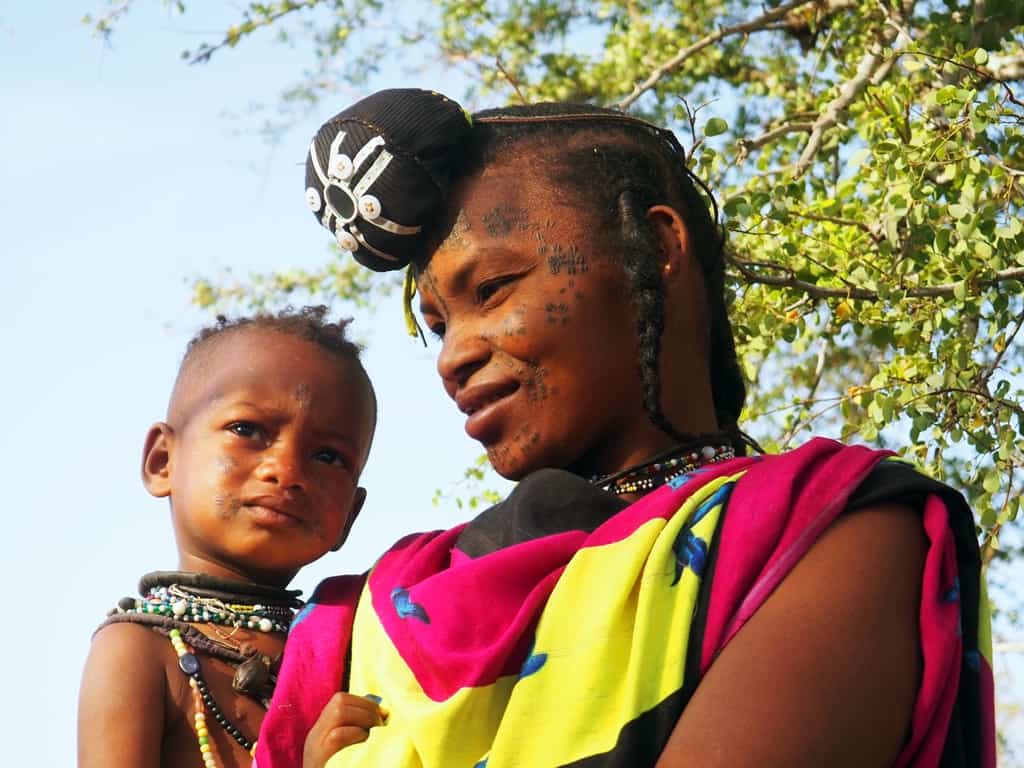
As we have noted, a woman may choose a new partner, but her children must remain with their father. This can be very complicated, since some children will see their mother leave and, some time later, see a new wife arrive.
Each wife is assigned a house in the camp, a number of cows to milk, and her own chores . They don’t necessarily get along with one another. In fact, this is often not the case, and it’s normal for them to find it difficult to share their man with others. As is usually the case, the oldest woman holds the highest authority in the camp.
The Wodaabe do not usually show affection in public. In fact, they do not even say the names of their wives, children, fathers, or mothers out loud. They explain this as a sign of respect, because showing feelings in public brings shame upon their loved ones.
The Aesthetics of the Wodaabe of Chad
One of the distinctive features of the Bororo, or Wodaabe, is their aesthetic. A sense of beauty is highly valued among this people, and they act accordingly.

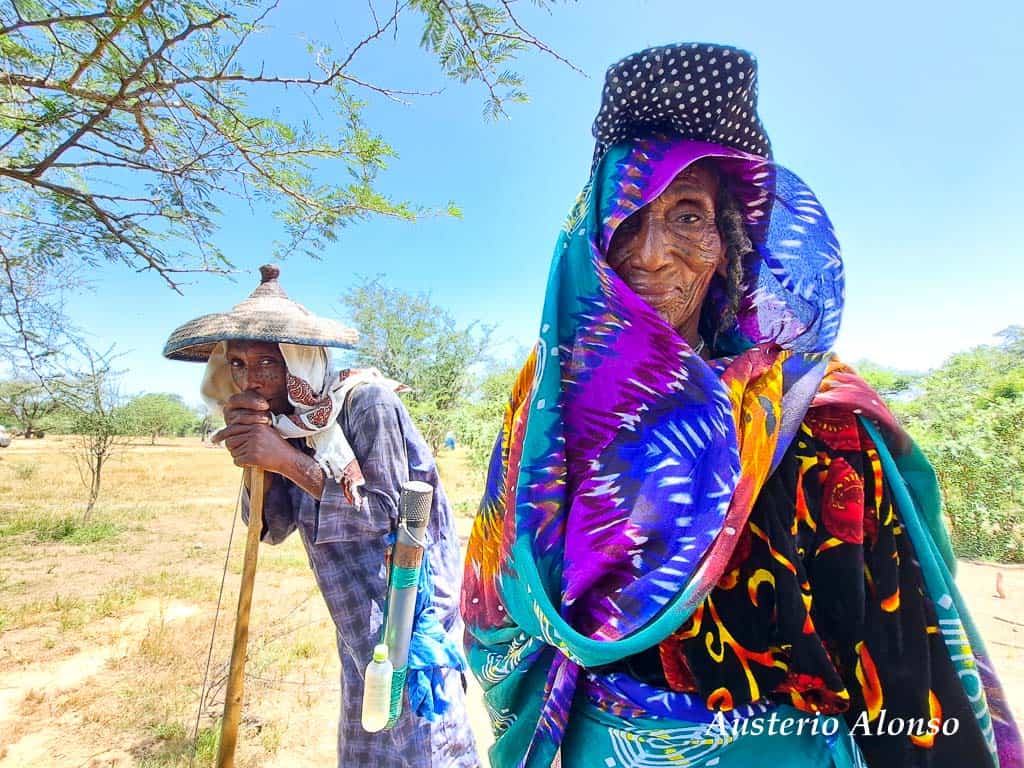
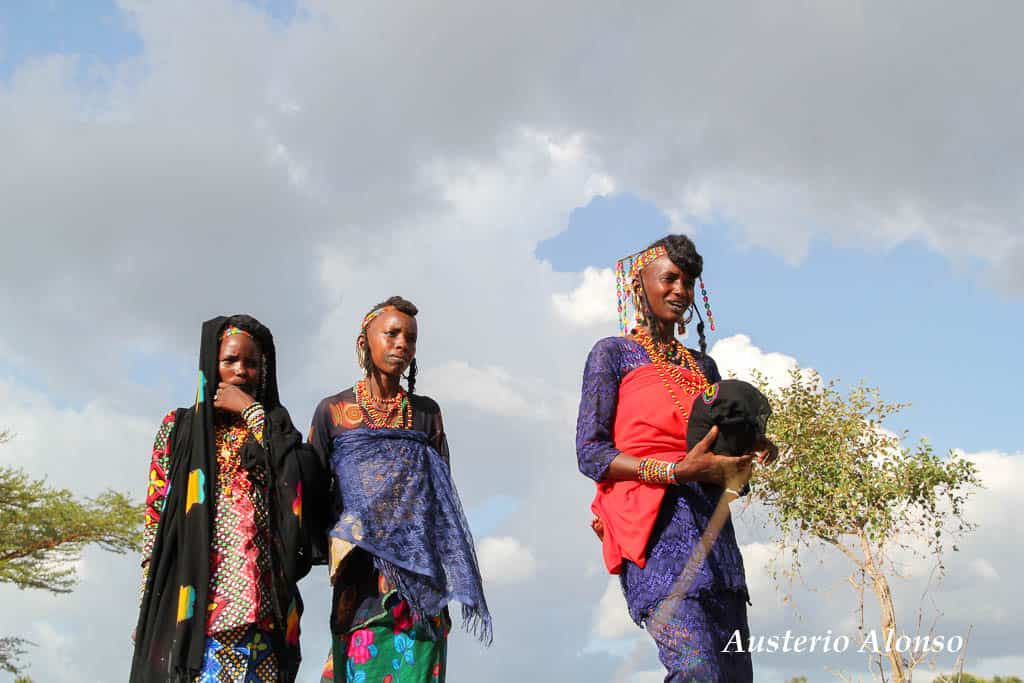
Women have tattoos and scarification on their faces. They are very elaborate and vary depending on the tribe to which they belong.
They also wear large earrings, necklaces, and bracelets, and their hairstyles always feature the two braids that frame their faces and protect them.
(Photo by Austerio Alonso)
However, once they are married and have children, they should not appear flirtatious. Only young, unmarried women can and should dress up in dresses, jewelry, and makeup.
Men in some groups also get tattoos on their faces, although they are much more austere in their day-to-day appearance. At the Gerewol festival, everything changes.

The Great Wodaabe Festival: Gerewol and Love
During the Gerewol festival, at the end of the rainy season, the Wodaabe men of Chad dress up and perform to attract the women’s attention. According to custom, it is up to the men to attract potential mates, and to do so, they must dress up as much as possible. Competition is fierce, so everyone strives to stand out from the crowd.
The men dress in bright colors and beads, and apply makeup that is as eye-catching as possible, using reds, ochres, yellows, whites, and blacks. They make their eyes look bigger with kohl, outline their noses with a vertical line, and highlight their lips with black or blue. A feather on their head and their hat make their face appear more stylized, as does a clean-shaven forehead. When they’re ready, they gather to dance in a circle, and the women come to watch them.


The Gerewol dance is accompanied by undulating movements, small jumps, and vibrations. But what stands out most are the exaggerated facial expressions they make, baring their teeth widely and opening their eyes wide. The dances take place at sunset and continue into the night, creating an even more special atmosphere.

If a Wodaabe man isn’t handsome (according to their aesthetic standards), he’ll have to make up for it with a seductive voice, an intense gaze, a sense of humor, charm, sociability, and so on. That’s what they call having “togu.”

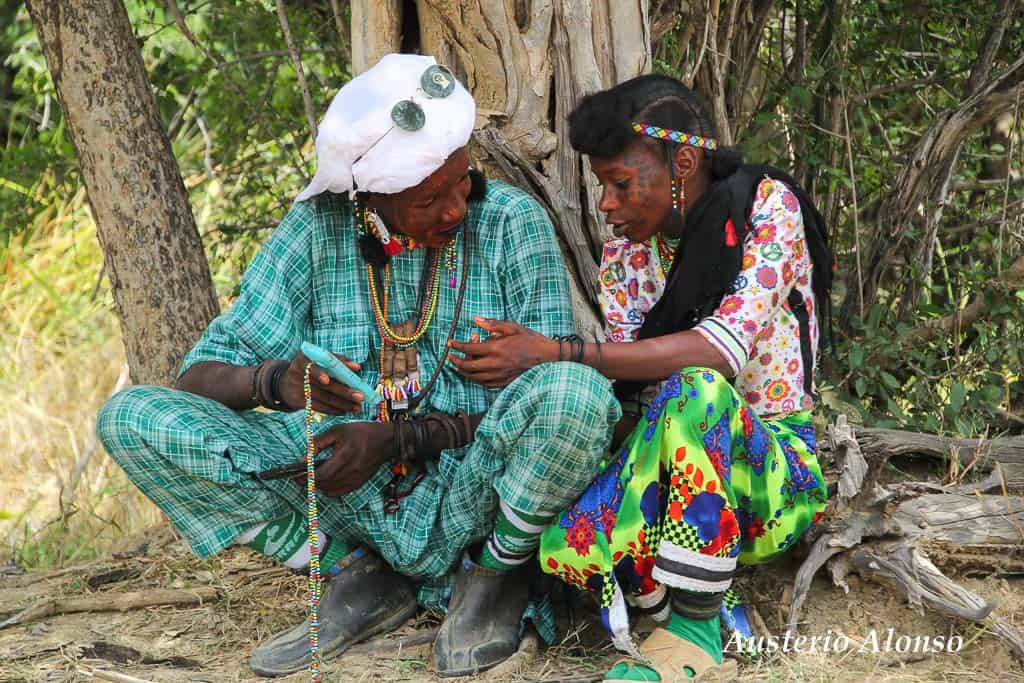
Gerewol is the festival where young people from different lineages have the opportunity to meet, fall in love, and get married. The young women are the ones who pick out the young man they like from among all those dancing, with their makeup and elaborate costumes. If he returns her gaze, she will lower her eyes as a sign of acceptance. Then he will approach her to talk, and over the next few days they will meet to chat and get to know each other better. Until one night, they will go “behind the bushes” for a much more intimate encounter.

What happens after the festival?
Sometimes a relationship doesn’t quite take hold during the Gerewol, but if the man is deeply in love, he will go to see her as many times as it takes to try to win her over. Even if that means walking several or many kilometers to her camp.
But wait a minute! If traditional marriages are arranged when people are still children, are there any single women?
In the Wodaabe tradition, marriage is not “forever.”
In other words, being married is not an obstacle at all. If a married woman meets another man at the Gerewol, he will go after her and “abduct” her at night, taking her to his camp. There, she will be accepted by his family, although at first she will sleep in a secluded spot.
Then a process begins that can last several days. The abandoned husband will try to persuade the other man not to take her away, but he will reject his arguments. Meanwhile, every night, she will get a little closer to her lover’s camp, until one day she herself agrees to become his official wife.
If things go well with the new partner, the relationship will last as long as their love endures. When things don’t work out, they’ll have the opportunity to find a new partner at the next Gerewol. Some women end up having several husbands, although they can only keep the children of their current husband—or orphans, if they have become widows.
There is no doubt that this system of marriage is a very clever set of rules for regulating romantic relationships and maintaining family units, ensuring their survival in—let’s not forget—a hostile environment.

Without a doubt, the Gerewol is one of the most fantastic spectacles to be seen in Africa, and a unique opportunity to get to know the Wodaabe people of Chad. A people with a culture far more complex than it may seem to us. In this video, you can get a sense of what Gerewol is all about:
Take a trip to Gerewol with Kumakonda
At Kumakonda, we remain committed to attending the Wodaabe people’s Gerewol festival in Chad every year, whether as a standalone trip or combined with visits to other destinations in Chad, such as the fantastic Ennedi Desert. If you’d like to join us on the next trip, please feel free to email us at info@kumakonda.com.
You can also check out our scheduled trips in the ” Trips” section of this website.
Documentation: Alicia Ortego and Austerio Alonso / ✍ Written by: Alicia Ortego / Photos: Austerio Alonso and Alicia Ortego

Autor:
Alicia Ortego
Content writer and author of the blog “Los Viajes de Ali”. A social anthropologist by training and passionate about Africa and deserts.
Travel with us