


Guinea-Conakry is a country that can only be truly understood by traveling through it slowly. Every stretch of dirt road brings with it a different scent, new vegetation, and languages that change from one village to the next. If you’re looking for an authentic experience in West Africa, this destination offers a deep immersion in ancient traditions that are still very much alive in every village. Here’s our selection of what to see in Guinea-Conakry.
- Text and documentation: Francesca Giustini
- Photos: Francesca Giustini and Austerio Alonso
Fouta Djallon: Guinea’s Mountain Garden
Fouta Djallon, one of the most beautiful regions in the country. It is a mountainous area covered in lush, almost tropical greenery, where the golden light of dawn illuminates rural villages that seem frozen in time
The air is cooler than on the plain. At night, a deep silence falls, broken only by the birdsong and the voices of children playing late into the evening.
Here, the cultural identity is deeply rooted and predominantly Muslim, something that is evident in the calm demeanor of its people and in the calls to prayer that mark the rhythm of the day.
In villages like Aïguel, life is organized around the community. The Fouta Djallon is also home to the Fulani (Peul), an ethnic group found throughout West Africa.
Traditionally semi-nomadic herders, the Fulani have developed a culture here based on discipline, social respect, and a strong bond with their livestock. All of this is integrated into the Islam they practice and a more sedentary way of life than in other countries. For this reason, their presence has shaped land management and the organization of villages.
In this region, waterfalls and rivers aren’t just tourist attractions; they’re the center of social life. The river is where people wash their clothes, spend time together, and chat.
As we walk toward those spectacular waterfalls and cool off in the clear, crystal-clear water, we watch women hanging cloths on the hot rocks and children jumping into the crystal-clear water. The atmosphere is one of absolute normality, yet we are surrounded by a spectacular landscape.

Malinké Culture: A Society of Guardians and Hunters, Spirituality, and Music
Inland lies the world of Malinké culture, the heirs to the ancient Mandinka Empire. Their society is organized into groups with very specific roles, in which each family plays an essential part in maintaining collective harmony.
We are talking about one of the most influential cultural systems in all of West Africa, as the Mandinka Empire once stretched across Senegal, Guinea, Mali, and Sierra Leone. Its legacy is still evident in social practices, music, and rituals.
The Griots (Djeli): Living Memory
The most fascinating figures are the griots, or djeli. They are often described as “musicians” or “storytellers.” However, this is a reductionist and misleading view, because they are so much more than that.
The griots are a hereditary caste of guardians of collective memory. Their role is to preserve and pass on the history, genealogies, alliances, and events that define the identity of the Mandé communities.
Through words and music, they have the power to strengthen relationships, resolve conflicts, and legitimize social and political roles.
Watching a griot in action is mesmerizing: when he begins to speak, the entire village stops to listen with reverent attention. In a society based on oral tradition, without them, history would be in danger of being lost to oblivion.
Their knowledge is passed down from generation to generation: from childhood, the chosen ones learn the techniques of storytelling, memory, and music, developing an extremely detailed understanding of the genealogical lines of the families they serve.

The Dozo: Guardians of Nature
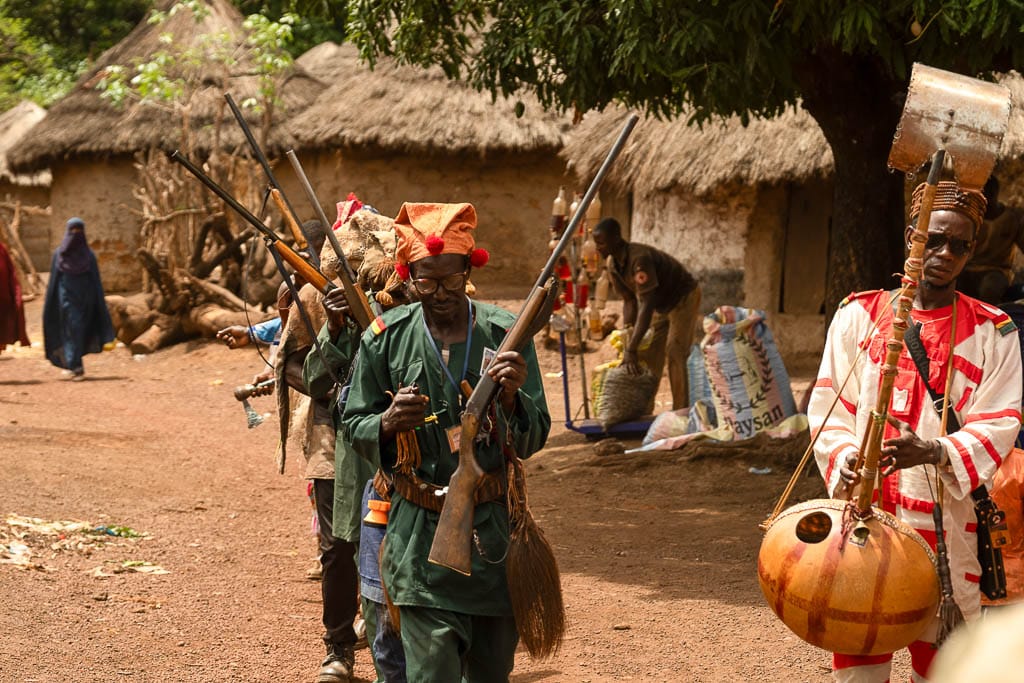
Alongside the Griots are the Doso (or Dozo): traditional hunters.
Their role goes far beyond hunting. They operate as a parallel security system that keeps watch while the town sleeps, serving as protectors of the community—a form of protection rooted in animism. Thus, they always carry protective amulets known as gris-gris, and they participate in rituals, working alongside the masks to ensure the collective’s protection.
In addition, they have a deep understanding of environmental cycles and natural medicine.
Interestingly, the path to becoming a Dozo is open to anyone—even women—through a learning process that takes time.
You can learn more about the Dozo in our article on this esoteric and powerful brotherhood of the Malinké people.
Masks and Spirituality: The World of the Invisible
On our trips to Kumakonda, we’ve been able to see the most important masks of this incredibly rich culture. Despite the influence of Christianity and Islam, animism endures—fortunately for all of us.
Masks are the physical manifestation of the spiritual world, and each one serves a specific purpose. Seeing them in person has a completely different effect than viewing a photo or watching a documentary.
The presence of these figures, the sounds, the movements, the smell of the dust stirred up by the dance, the heat of the fire all around. It all puts you in a state of total focus.

Among the various masks found in Malinké culture, the following stand out:
Koma: A stylized, geometric wooden figure with abstract features, slit-like eyes, and a prominent nose. It represents an ancestral spirit of the forest and, in the Malinké context, appears in male initiation rites. Its function is disciplinary, educational, and spiritual: it transmits knowledge and connects the initiates to the invisible laws that govern the community.
Soli Wulen: literally “red panther” (soli = panther, wulen = red), is the most striking mask of all. It consists of a costume made of dense red fibers that move with every gesture, mirrors to ward off negative energies, and bells that enhance its presence. Its movements mimic those of a panther. It acts as a protective and healing force during community celebrations. The overall effect is that of a creature that truly seems to have come from another world. It appears during initiation rites (Solima) and in community celebrations as a protective force.
Signon sonfö: Visually complex and sometimes intimidating, featuring animal forms, horns, and many other overlapping elements. It is associated with secret societies and is used for conflict resolution and social justice.
Gnana koudouni: It has a more compact and distinctive shape, with human features and a calm, authoritative expression. It is associated with ancestral wisdom and the transmission of knowledge: it represents elderly figures or spirit guides. In the Malinké tradition, it plays an educational and moral role, reminding the community of the importance of memory and respect for traditions.
Konden: This is probably the most representative of Malinké culture—and also the most spectacular. It is an imposing figure with exaggerated facial features and elaborate costumes made of fabric and fibers, designed to be seen in motion. It is used during communal rituals and celebrations. It can represent spirits, warriors, or mythological figures. Its expressive power leaves you speechless, and the audience reacts by cheering and clapping. The energy it creates is something that really moves you.

Music: The Connecting Tissue of Guinea
In the Kankan region, the cultural heart of Malinké country, the towns come alive with traditional music in a way that is hard to imagine.
You hear the music even before you see who’s playing, and when you reach the town center, you find groups of musicians playing the djembe, dunun, and balafon with complete ease. It’s as if they were breathing through their instruments.
Each activity has its own specific musical rhythm, and as the days go by, you begin to recognize them: the rhythm of work in the fields, that of celebrations, and that of evening gatherings. They always accompany the masks and the appearance of the Dozo.
Dances, such as the Dundunba—known as the “dance of the strong men”— are expressions of identity, strength, and belonging. They draw you in even just by watching them, because the energy is contagious and the rhythm gets into your body, whether you want it to or not.
Traditional Instruments of the Mandé Culture
In communities like Tabato, music, dance, and crafts intertwine to form true cultural hubs.

Collective Rituals: The Fête de la Mare
One of the most powerful examples of Malinké social cohesion is the Fête de la Mare, which is celebrated in Dalamon.
It is an annual communal fishing ceremony held at a sacred pond. The entire village participates at the same time, following shared rules, in an atmosphere that is both festive and solemn, until, suddenly, hundreds of people enter the water all at once.
The fish caught is not sold individually but is redistributed or preserved—often by drying—as a common resource for the entire community.
The Fête de la Mare is a concrete example of how, in the Malinké world, the economy, ritual, and social organization are all part of a single system—one in which the rhythms of work, nature, and community converge. It’s one of those things you have to see to truly understand.

Conakry: Where Tradition Meets the City
The capital, Conakry, offers a stark contrast: chaotic traffic, the smell of the ocean mixed with that of the fish markets, and an overflowing urban energy. However, cultural continuity remains very much alive.
The city brings together people from all regions of the country and has become a diverse space where languages, traditions, and identities continually intertwine. It is also a place where traditional practices find new forms of expression through venues dedicated to dance, music, and the performing arts.
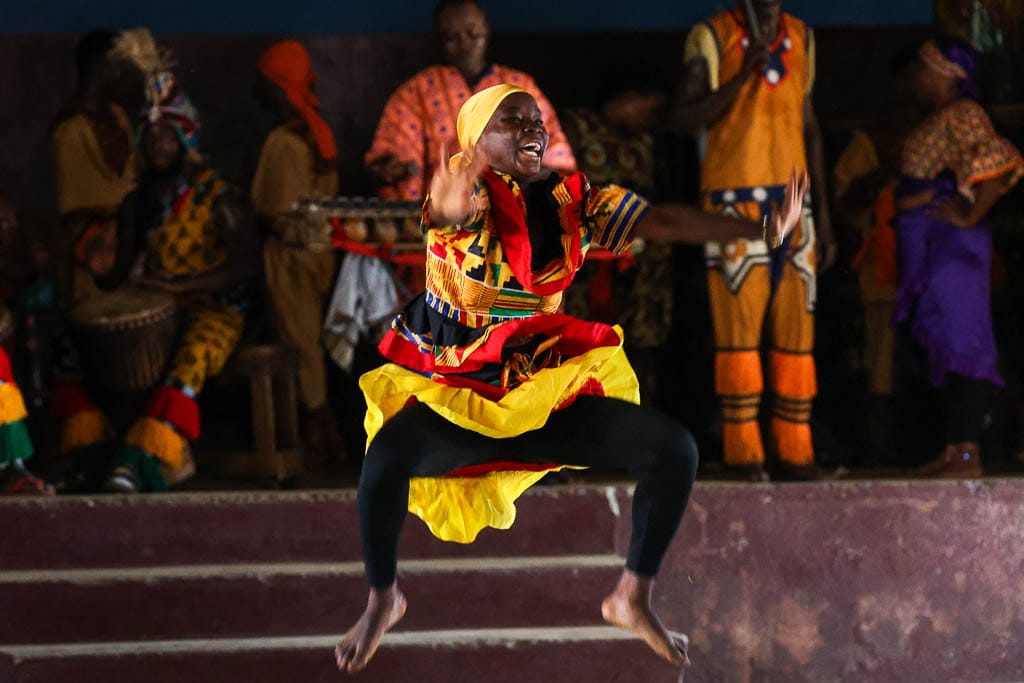
A visit to the acrobatic center rooted in the tradition developed by Fodeba Keïta is a must, where the body becomes an instrument of cultural transmission, or to attend a rehearsal of Les Merveilles de Guinée, a renowned ballet company that has been dedicated to training young people in dance, singing, and percussion since the 1980s.
Watching these young people perform with such astonishing precision and discipline helps us understand that Guinean tradition is not something static, but a living culture that reinvents itself every day.
Conakry represents a different facet of the same cultural world found in the villages. It is an urban reinterpretation of those same symbolic and social structures, and discovering it in person is one of the most beautiful surprises of the entire trip.


Frequently Asked Questions About Guinea-Conakry
What are the road conditions like?
The trip is usually taken in a 4×4 because the roads are full of potholes and the journey can be long and dusty. However, the scenery—filled with mango trees and lush vegetation—makes the effort worthwhile.
Which ethnic groups are predominant?
You will mainly encounter the Fulani (Peul), who make up about 30–40% of the population, the Malinké in the interior (another 30%), and the Soussou in the capital area.
Is it hard to get around the country?
Guinea is a place that calls for a slow pace. Traveling through this country means accepting that you can’t always control every step of the way, and you have to let the journey take you where it will.
Why include Guinea-Conakry on a trip to West Africa?
Why not? From the Fouta Djallon Mountains to the Malinké region with its masks and Dozo hunters, through the urban vibrancy of Conakry, the country displays a cultural continuity that spans territories that are very different from one another.
It’s a trip you’ll never forget, and we hope we’ve inspired you with this selection of places and cultures to explore in Guinea-Conakry. If you’d like to travel with us, check out the “Travel” section on this website to stay up to date on our itineraries, and/or subscribe to our newsletter.

Autor:
Austerio Alonso
Co-founder of Kumakonda. Passionate of Africa. Specialist in the design, preparation and realization of expeditions in Africa. Content creator.
Travel with us