


Loango National Park in Gabon: Jungle, Beaches, and Wildlife
Loango National Park, on Gabon’s Atlantic coast, brings together within a single area some of the most spectacular landscapes of Equatorial Africa: rainforest, savannas, lagoons, mangroves, rivers, and kilometers of virtually uninhabited beaches.
It is also one of the most iconic places to observe wildlife in the forests of Central Africa. Elephants, forest buffalo, hippos, western lowland gorillas, various species of primates, and an extraordinary diversity of birds inhabit a park where the jungle ends right at the Atlantic Ocean.
Loango became known outside of Gabon for its photographs of elephants, buffalo, and hippos on the beaches. However, this image represents only a small part of a much more complex region.
To get to know Loango, you have to understand its seasons.
With the rains, the water transforms large areas of the park, and the coastline takes center stage. During the dry season, our exploration heads inland, following ancient riverbeds to Akaka, one of the most remote and wild areas of Loango.
These are two very different ways to explore the same park.

How to Get to Loango National Park from Libreville
The trip to Loango begins in Libreville, the capital of Gabon.
From there, we crossed by sea to Port-Gentil on a ferry—which runs two or three times a week between these two cities—or on daily domestic flights to the major oil city on the Gabonese coast. This is the first journey south and also the beginning of a gradual transition from urban Gabon to increasingly sparsely populated areas.
From Port-Gentil, we continued overland to the Iguéla Lagoon, one of the natural gateways to the northern sector of Loango National Park.
From this point on, the roads are no longer the main focus.
To truly explore Loango, you have to walk and sail.
Boats allow us to explore lagoons, rivers, and canals that wind through the jungle, while hiking trails take us into parts of the park that are inaccessible by road.
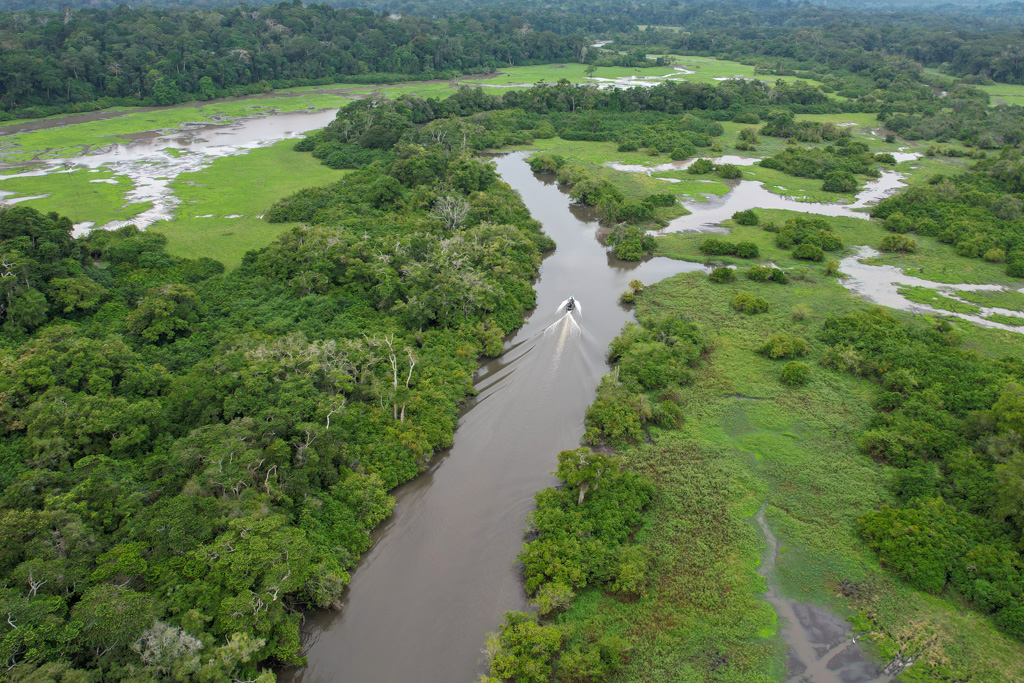
Iguéla, one of the gateways to Loango
The Iguéla Lagoon marks the entrance to a landscape dominated by water.
From its banks, we can venture into a vast system of lagoons and waterways surrounded by forests, savannas, and floodplains.
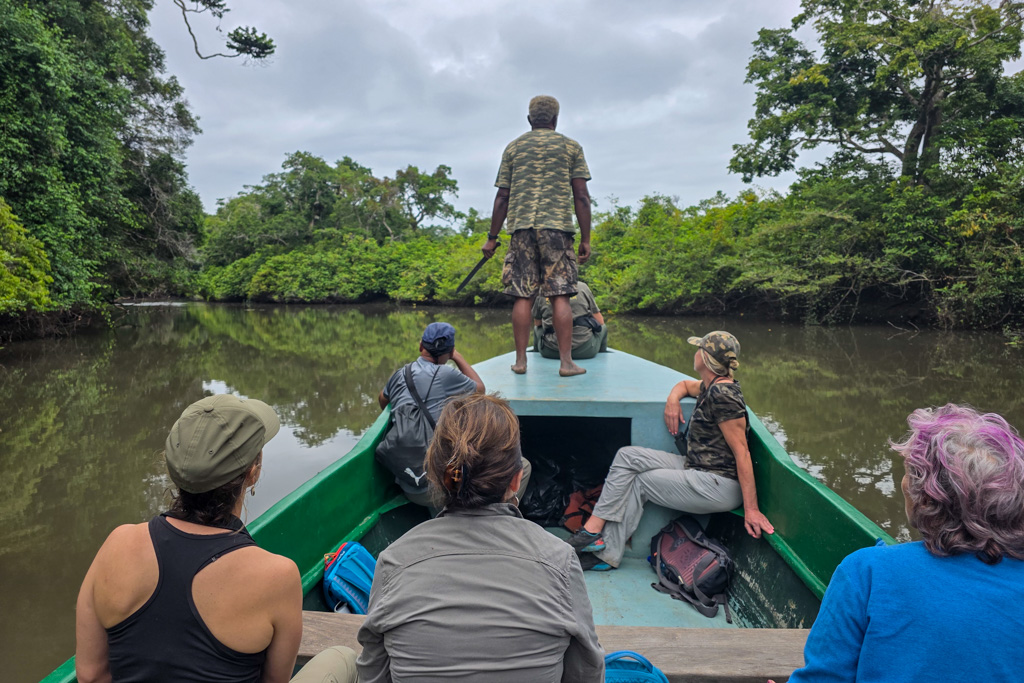
Boating is an essential part of any in-depth exploration of Loango.
We move slowly, keeping a close eye on the riverbanks. In the equatorial jungle, animals rarely stay in view for long. A movement in the vegetation, fresh tracks in the mud, or the sound of breaking branches may be the first sign that an elephant is nearby.
It’s a completely different way of observing wildlife than a safari on the vast African savannas.
In Loango, you have to look around.
Akaka, grasslands teeming with wildlife during the dry season
One of our main goals during the dry season in Gabon is to reach Akaka.
Akaka is located within the park, in a region of forests, rivers, swamps, and vast areas that remain flooded for part of the year.
When the rains subside and the waters begin to recede, grassy areas appear that attract numerous animals.
Forest elephants, buffalo, capybaras, primates, and various antelopes use these open areas to forage.
The landscape is constantly changing.
In some places, we travel along old forest trails. In others, the vegetation forces us to follow the waterways. Dense jungle, clearings, swamps, and rivers make up a landscape where distances aren’t measured solely in kilometers.
Reaching Akaka is part of the expedition.
Hike from Sounga to Inyougou
One of the ways we explore Loango during the dry season is by hiking between Sounga and Inyougou.
The challenge lies in the equatorial forest itself: the heat, the humidity, the terrain, and the hours spent walking through a landscape where the vegetation constantly obstructs the view.
During the hike, we passed through areas of jungle and old trails that are also used by wildlife.
This is where our perspective changes.
We no longer just look for animals. We learn to recognize the signs of their presence: fresh tracks, droppings, broken branches, churned-up mud, or paths cleared by elephants through the vegetation.
Sometimes we hear animals before we see them.
Other times we know that only a few hours have passed, but they never actually show up.
That uncertainty is part of walking through Loango.
From Inyougou to Akaka: Sailing Inland
At Inyougou, we stopped walking and continued by boat to Akaka.
The shift in perspective is immediate.
From the water, we slowly make our way through a network of rivers and canals surrounded by jungle. Traveling by boat allows us to reach places that are virtually inaccessible by land and to scan the banks for any movement among the vegetation.
During the dry season, when water levels drop and new grasses emerge, there are more opportunities to spot wildlife feeding in certain open areas.
Loango doesn’t work that way.
In a rainforest ecosystem, every encounter holds an element of the unexpected.
Sleeping in the Akaka Jungle
Spending several days in Akaka allows you to explore the park at a different pace.
During our expeditions, we camp in the Loango interior, spending our days alternating between boat trips and on-foot excursions in search of wildlife.
Staying here is part of the experience.
When night falls, virtually all signs of human presence disappear. All that remains is the forest, the water, and the sounds of the animals.
The next morning, we’ll go for a walk or a boat ride again.
This slow pace is important. In the equatorial rainforest, it doesn’t make much sense to rush through the area hoping to rack up sightings.
You have to put time into it.
Sette Cama and the beaches of southern Loango
The landscape changes once again in Sette Cama, in the southern part of Loango National Park.
Here we find another of the park’s major landscapes: Ndogo Lagoon, the forest, and the Atlantic beaches.
The jungle ends practically right at the ocean.
These are vast beaches, with kilometers of sand and very few people. Immediately behind them lie forests and other ecosystems used by wildlife.
Sette Cama becomes particularly interesting during the rainy season, when the distribution of animals within Loango changes.
And that’s when we came across one of the most extraordinary images of Gabon.
Elephants, buffalo, and hippos on the beaches of Loango
Photos of elephants walking along the beaches of Loango have been seen around the world.
They aren’t just a publicity stunt. Large jungle mammals can make their way all the way to the coast.
But it’s not something that happens every day, either.
During the rainy season, especially between November and the first few months of the year, there is a greater chance of spotting elephants and forest buffalo venturing near the beaches. Hippos may also appear at this extraordinary meeting point between the jungle and the Atlantic.
Finding them takes time, travel, and a bit of luck.
The animals are completely wild and roam a vast territory. There are no set times or places where we can guarantee they will be present.
We can walk for kilometers along the beach without seeing anything.
And one day, discover an elephant’s footprints in the sand and start following them.
For us, that search is precisely one of the reasons we travel to Loango.
Sea Turtles in Gabon
During the rainy season, another of the Gabonese coast’s major natural events also takes place.
Sea turtles come from the Atlantic to lay their eggs on the beaches.
Among them is the impressive leatherback turtle, the world’s largest sea turtle.
At the right time of year, you can walk along the beaches at night looking for females that come out of the ocean to lay their eggs.
Weeks later, another cycle begins, when the baby turtles emerge from the sand and try to reach the ocean.
As with the rest of Loango’s wildlife, observation must be conducted in accordance with conservation protocols and without interfering with their behavior.
Western Lowland Gorillas in Loango
The western lowland gorilla is another of the large animals that inhabit the Loango forests.
Gorilla watching in Gabon is a completely different experience from encounters with mountain gorillas in Uganda or Rwanda.
We are in the ecosystem of the vast forests of the Congo Basin.
The vegetation is dense, visibility is limited, and humidity is constant. The forest dictates how we approach the area and also how we observe the animals.
Loango helps us understand that Gabon is not just a destination for spotting elephants on the beaches. It is, above all, a country of equatorial rainforest.
When to Visit Loango National Park
One of the most important questions to ask before planning a trip is when is the best time to visit Loango.
Our answer is simple:
It depends on what we’re looking for.
Loango during the dry season: hiking and the Akaka Forest
During the dry season, which generally lasts from June through September, conditions allow visitors to explore the park’s interior in a different way.
This is the time of year we use to combine the Sounga–Inyougou trek, a boat trip, and several days in the Akaka area.
As the water recedes, it reveals grazing areas used by wildlife and makes it easier to travel through the interior.
In addition, during these months, humpback whales arrive in the waters off the coast of Gabon as part of their migration.
It’s the Loango of the interior.
Jungle, hiking, rivers, boating, and wildlife spotting.
Loango During the Rainy Season: Animals on the Beaches
With the arrival of the rains, the park changes.
Large areas are flooding again, and animals are changing their patterns of movement.
Then our attention shifts to the coast.
This is the time of year when you have the best chance of spotting elephants, buffalo, and hippos on the beaches of Loango, and it also coincides with the arrival of sea turtles to lay their eggs.
It’s another Loango.
Neither better nor worse.
Different.
That is why exploring the park during different seasons is essential to understanding it.
Fauna of Loango National Park
Loango is home to an extraordinary diversity of wildlife typical of the forests of Central Africa.
Some of the animals we can find include:
- forest elephants;
- forest buffalo;
- Western lowland gorillas;
- hippos;
- potamokeros;
- various species of forest antelopes;
- primates;
- crocodiles;
- sea turtles;
- numerous species of birds.
At certain times of the year, we can also see humpback whales and dolphins off the coast.
But a list of species can give a misleading impression of Loango.
Here, we don’t go on a safari through an open savanna where animals can be seen from hundreds of meters away.
We’re in the jungle.
An elephant may be very close by yet remain completely hidden behind the vegetation.
That’s why every footprint matters and every encounter has a different value.
Loango, one of Gabon’s great natural areas
There are places you can see on a quick visit.
Loango is not one of them.
Its size, the difficulty of getting around, and the enormous diversity of ecosystems make it necessary to set aside time to explore the park.
And above all, you have to get around in different ways.
Walk. Sail. Wait. Go back and look again.
It’s the only way we know of to truly explore this territory.
After several days, the connections become clear: we understand where the elephants move, how the landscape changes as the water recedes, why certain animals gather in specific areas during the dry season, and why the beaches take center stage when the rains return.
So Loango is no longer just a national park.
It’s starting to become a territory.
Travel to Loango National Park with Kumakonda
At Kumakonda, we have explored Loango at different times of the year, and we plan our expeditions based on the season and the conditions we encounter on the ground.
During the dry season, we head inland—to Sounga, Inyougou, and Akaka—hiking and boating to spend several days in some of the park’s most remote areas.
With the rains, we set out in search of another Loango: Sette Cama and the Atlantic beaches, following the movements of the wildlife and looking for elephants, buffalo, and hippos near the ocean.
Loango preserves precisely what we seek on many of our trips through Africa: places where it’s still necessary to invest time, walk, navigate, and embrace uncertainty.
Here, nature still dictates the terms of the journey.

Autor:
Austerio Alonso
Co-founder of Kumakonda. Passionate of Africa. Specialist in the design, preparation and realization of expeditions in Africa. Content creator.
Travel with us