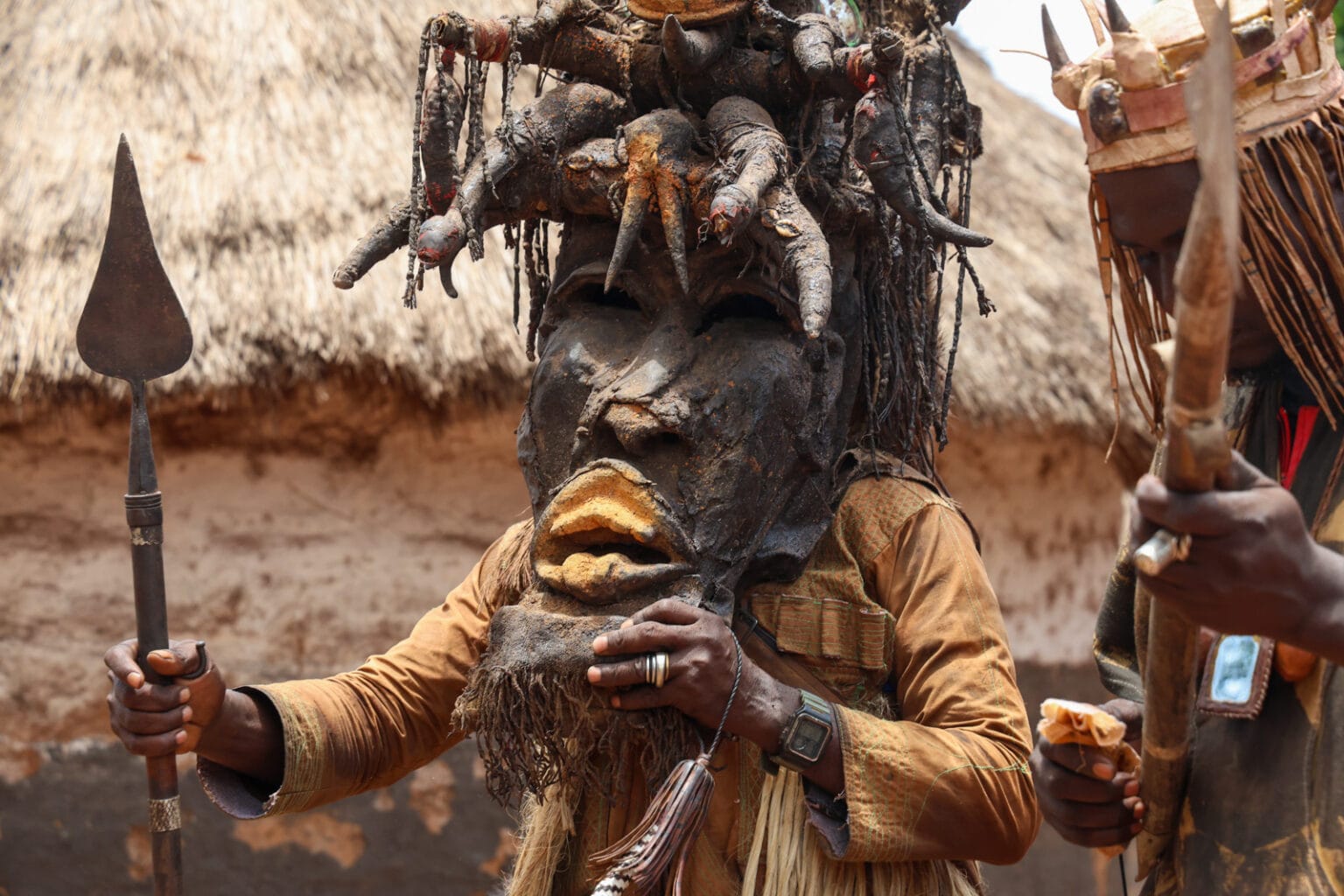
Casamance, in southern Senegal, is a region physically separated from the rest of the country by The Gambia, but above all it is a territory with its own distinct character, where geography, social organisation and cultural practices are deeply intertwined.
Casamance, Senegal: What to see: Diola culture,
Ziguinchor, fishing and hidden villages
In Casamance, the landscape is at once infrastructure, memory and economic structure. Rivers are not natural boundaries, but routes of communication. Forests are not merely a scenic backdrop; they are regulated and sacred spaces. Villages are not isolated units, but nodes in a wider network that connects communities, resources and rituals.
For this reason, Casamance is not explored as a series of attractions, but as a complex system in which each element contributes to a coherent structure that remains active and visible in the region to this day. From fishing in the riverside villages to towns such as Ziguinchor. And from the customs of the Diola culture to the sacred spaces of the forest.
We’ll talk about all of this below, because we want to introduce you to one of the most inspiring destinations we’ve ever visited, and we want to continue exploring it further with our groups.
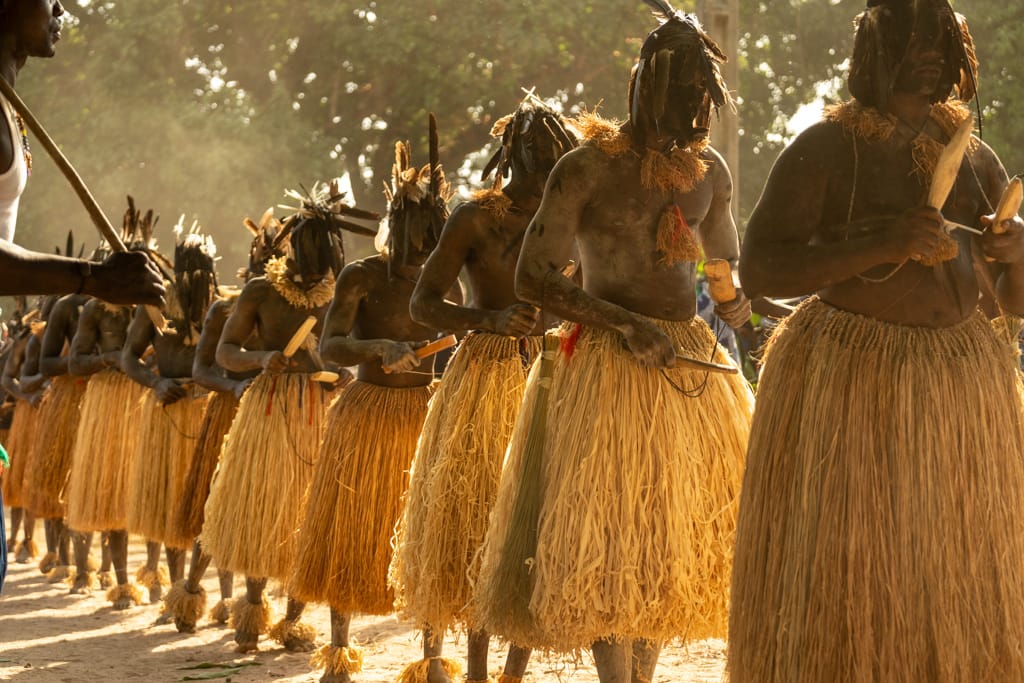
The Diola culture in Casamance: social organisation, the forest and rituals
The Diola (or Jola) culture represents one of the most complex and coherent social systems in Casamance, characterised by a strong continuity between community organisation, territory and the spiritual dimension.
It is not a homogeneous group, but rather a network of communities and sub-groups spread across Senegal, The Gambia and Guinea-Bissau. They are united by a shared language, rituals and values, whilst at the same time being distinct at a local level, depending on specific villages, clans and ecosystems.
The entire social system is deeply intertwined with work, particularly rice cultivation and the management of the fields, which represent not only an economic resource but also a key aspect of identity and culture.
Courage and individual responsibility are values rooted in a historically autonomous and resilient tradition, which has also developed in response to centuries of contact, resistance and transformation brought about by colonial presence and subsequent Christian and Islamic religious influences.
Despite these influences, the majority of the Diola people still maintain a strong connection with their original animist tradition. This is based on the worship of the boekin, spiritual entities that act as intermediaries between humans and the supreme god Emit or Ata Emit. This god is often associated with natural cycles such as the sky, rain and the seasons.
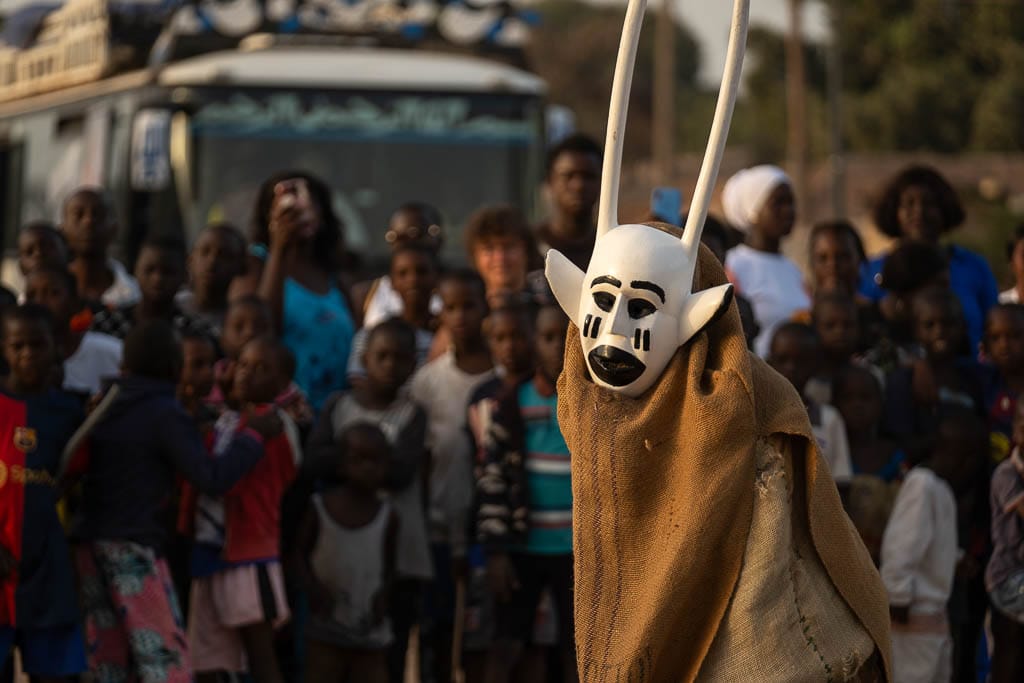
This cosmology also encompasses family totems (ewn), associated with symbolic animals such as crocodiles or snakes, and protective spirits charged with safeguarding families, villages and rice fields. They are the guardians of everyday social and religious life.
Among the most important rituals and ceremonies practised in Casamance—and which we have attended—are:
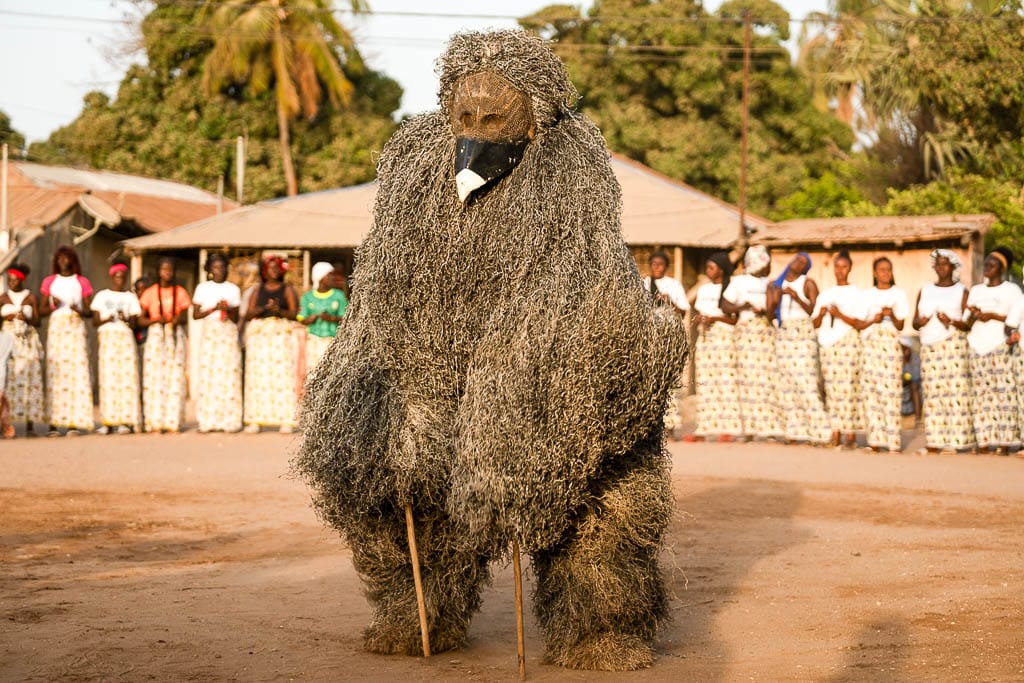
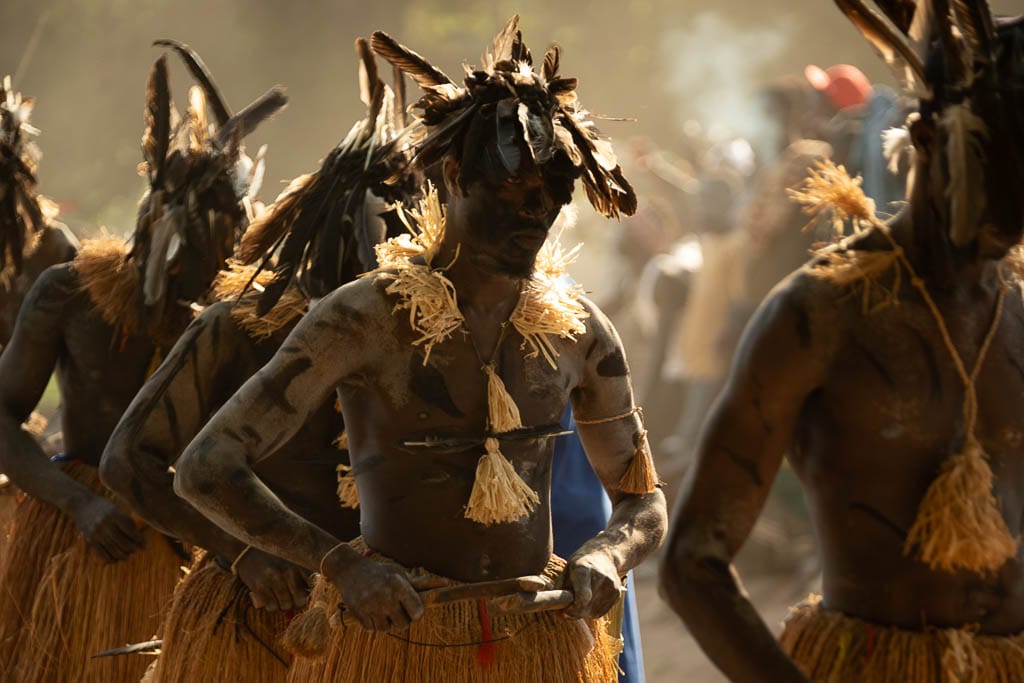
- Kumpo, a masked figure associated with the spirits of the forest. It appears during public ceremonies not as a spectacle, but as an element of social regulation.
- Kahate, a male initiation rite marking the transition to adulthood through a process of training, isolation in the forest, tests of endurance and the transmission of traditional knowledge. It culminates in circumcision and full integration into community life.
- Karahay, a female initiation linked to social maturity and the continuity of the community. It takes various forms, but shares the same structural value of transmitting knowledge, discipline and social integration.
Attending the Kumpo means suddenly finding yourself in a situation steeped in symbolism and emotion.
First come the drums; the children run and play, whilst some women approach, laughing and shouting at the same time. Then they form a circle as the brass instruments begin to play. The men start to sing and the tension slowly builds.
Then he appears: a figure spinning dizzyingly round and round until he seems almost unreal. Seeing him in person is an incredibly powerful and deeply immersive experience.
For a few moments, one gets the feeling that the whole village enters a different state, suspended between fear, awe and collective euphoria. Even from the outside, it is impossible not to sense that this moment carries real social and spiritual significance for the community.
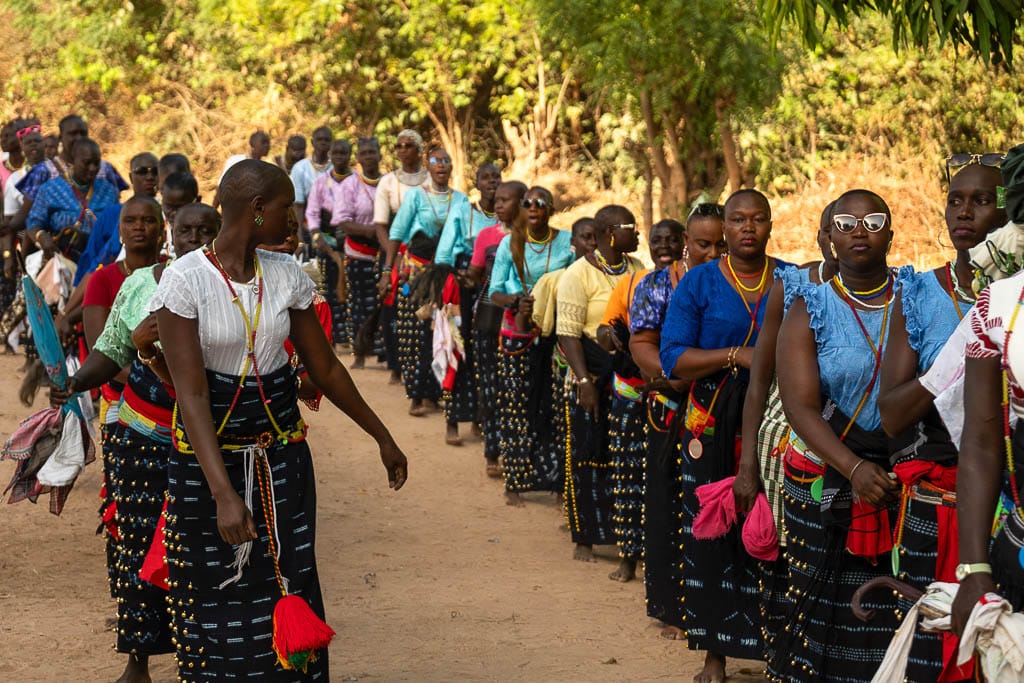
During the ceremonies associated with the Kahate and Karahay initiations, the atmosphere changes completely. The villages are filled with tension, anticipation and pride. It is clear that these are not merely folk celebrations, but moments that define a person’s role within the community.
We, too, experience that sense of anticipation alongside the community, sharing the feeling of waiting for something profoundly important.
As the hours passed, curiosity grew, but above all, so did the excitement at finally seeing these men and women emerge from the sacred forest, after days or weeks of isolation and transformation. At such moments, it becomes clear that the forest is not merely a physical space, but a symbolic place of transition between who one was before and who one will become.
If you’d like to find out more about Diola initiation rites, don’t miss our articles and photos:
- Kahate, a male initiation rite of the Diola people of Casamance, Senegal.
- Karahay or Karahaye, the female initiation rite of the Diola people of Casamance, Senegal.
Kafountine and Ziguinchor: fishing and the daily economy
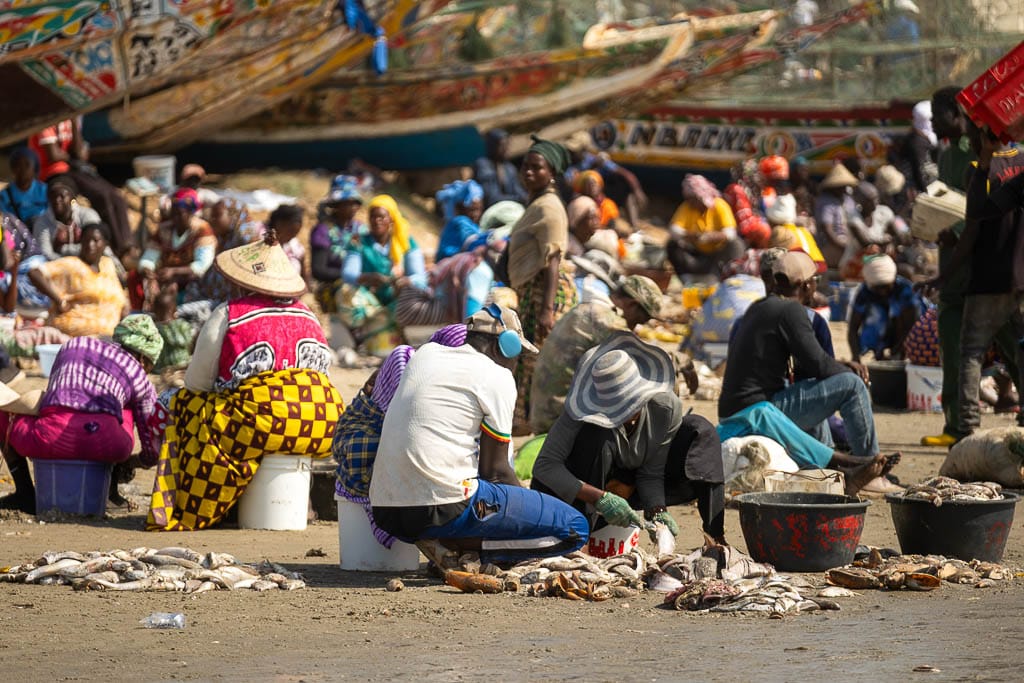
During our stay in Kafountine, we walked along the beach, which has always been the heart of the fishing industry in Casamance.
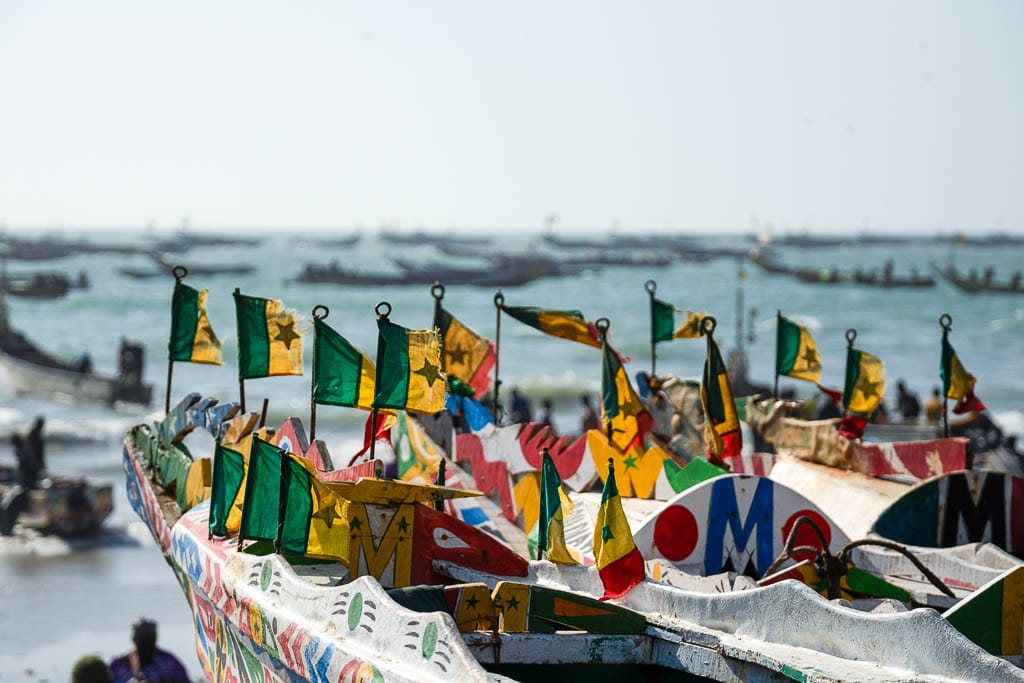
It is not a port in the traditional sense, but rather a long stretch of sand where hundreds of boats set out and return, unloading, cleaning and selling large quantities of fish.
Fishing cannot be viewed as an isolated economic sector, but rather as one of the structural elements of the local social organisation.
The first thing that strikes you on arriving in Kafountine is the sensory intensity of the place. The smell of dried fish and the smoke from the bonfires lit on the beach reaches you long before the sea.
Everywhere there are people carrying crates, women cleaning fish whilst sitting on the sand, children running between the colourful canoes and men dragging nets under the sun.
The harbour seems almost like a living organism, chaotic yet perfectly synchronised. Every space is filled with a specific activity: some are mending nets, others are sharpening knives, and still others are shouting out the prices of the freshly unloaded fish. And whilst everything moves at a rapid pace, in the background there is the constant sound of the waves, the salty ocean breeze and hundreds of seagulls circling above the boats as they follow the return of the fishing boats.
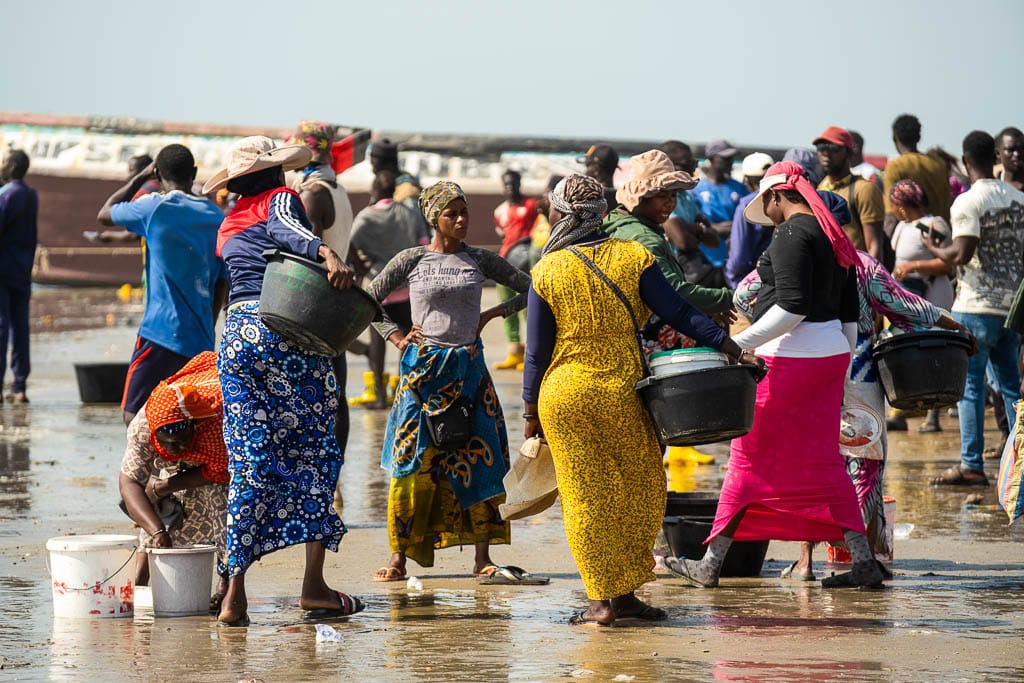
Along the coast and in riverside villages, economic activity does not follow the industrial logic of large-scale production. Instead, it takes place within a network of small-scale craft industries that is deeply embedded in the community and its daily rhythms.
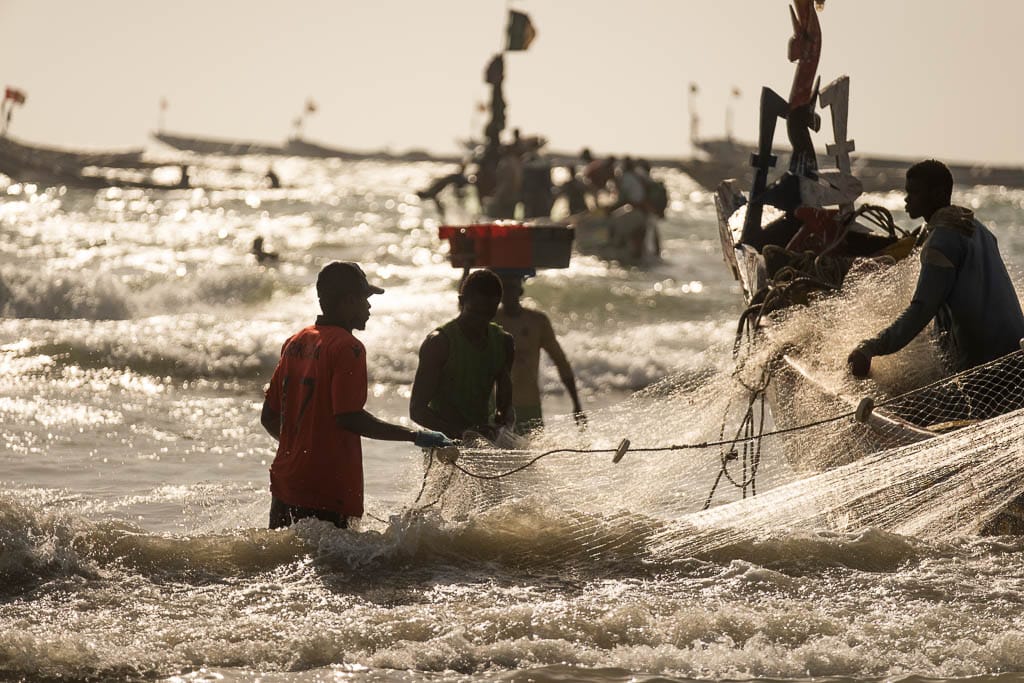
Traditional canoes set out at dawn and return during the day, depending on sea conditions, the time of year and the knowledge passed down within families and communities. Technical knowledge is inseparable from the social context in which it is applied.
The key point is not just the act of fishing, but what happens immediately afterwards. The fish does not enter a distant or fragmented production chain, but is processed, distributed and sold in the very place where it is landed. In other words, this process bridges the gap between production and consumption, creating a seamless economic system.
In this context, Kafountine is one of the clearest examples of this economic model. The port is the hub of all local economic activity.
Abéné and the Ceiba: a sacred tree, everyday use and spiritual continuity
To gain an even deeper insight into the culture of southern Senegal, it is well worth stopping off at Abéné, home to one of the most striking features of the local landscape: the Ceiba pentandra (also known as the fromager or kapokier tree).
This ceiba is an imposing tree that can grow up to 70 metres tall and dominates the surrounding area both visually and symbolically.
The Ceiba is not seen as a mere natural feature, but as a sacred entity, integral to a belief system that remains alive today. In many local communities, it is associated with a female spirit and recognised as a point of connection between the natural and spiritual realms.
Historically, people would visit these trees to pray to the spirit of the Ceiba and ask for fertile soil and bountiful harvests. The area behind the tree—often characterised by the presence of water—was used particularly by women for requests relating to their own fertility and the continuity of the family line.
Today, these practices have not disappeared entirely: the Ceiba is still perceived as a place of protection and interaction with the invisible world, albeit in forms adapted to the present day.
In addition to its spiritual dimension, the Ceiba also plays a material role in the local economy. The fallen leaves are collected and, after being burnt, used for soap production, whilst the so-called ‘cotton’ from its fruits is used to make cushions and fillings.
This work is traditionally carried out by women, who transform a natural resource into a material for everyday use. A direct link is thus maintained between the environment, the domestic economy and traditional knowledge.
Conclusion: Why Include Casamance in a Trip to Senegal
If you’re wondering what to see in Casamance, the answer isn’t a fixed list of places, but rather a range of experiences that help you understand how this region of Senegal works.
From Diola culture to ritual systems, from coastal fishing to places like Kafountine or Abéné, each element helps define a region where the economy, community and spirituality remain deeply intertwined.
Casamance is one of the most authentic areas of Senegal, but also one of the least immediately accessible to interpret. Precisely for this reason, it offers an alternative to the more touristy itineraries.
Including it in a trip to Senegal, or taking a trip dedicated solely to Casamance, means going beyond the well-known destinations and accessing a deeper dimension of the country, made up of villages, traditions and local systems that are still very much alive.
It is not an experience for those seeking only iconic sites, but for those who truly wish to understand how daily life is lived in this part of West Africa.
- Text: Francesca Giustini
- Photos: Francesca Giustini and Austerio Alonso